Tuesday, July 28, 2020

Felipe Galindo(Feggo) : When the conversation turned to the vague?

When the conversation turned to the vague?

Reforming art and cultural activities to meet today’s needs can be a great way to promote harmony. 

by Luchia Meihua Lee


New York artist Felipe Galindo, has dedicated himself to creating humorous art in a variety of media, including cartoons, illustrations, animations, fine art and public art. He is also an arts educator. Many of Felipe's "It Used / Reused" ongoing series drawings remind of us pre-pandemic life and highlight the differences. the new life been giving to the used bag, cup and boxes the image that profile the continues living style in the city, while we are turned away from people by a lingering, invisible threat. Figures appear in parallel or in a semicircle or diagonally across from each other in the drawing's clustered space, the bodies either half-turned away from us, or shown in profile. These people do not wear face masks, but neither do they open the mouth; they rather fall into a friendly but silent atmosphere.

The drawings from the Used / Reused series have been compiled with Felipe Galindo‘s eye for reusing hang bags, train or bus tickets and subway maps, as well as paper cup and take out boxes. Preceding the pandemic, they nevertheless shed new slight on our new socially distant lives, as evidenced by the guarded conversation between figures in the drawings, figures scattered seemingly at random and placed unwillingly on the same plane. There is no tangible emotion or special anguish expressed by these people. 

In "Coffee Shops III-VI, they are situated behind and in front of counters that turn out to be familiar take-out cups unrolled in semicircular arcs in settings such as the cafes or bars where patrons play with cell phones or computers. Viewed in light of Covid-19, these scenes are reminiscent of one's affection for what has been cast off in these pandemic days. They are perfectly chosen for this moment. Paradoxically, we seem to be working and thinking disconnectedly in the virtual world in the midst of the virus. Imagine arranging in-person visits to museums, galleries,and auction houses to view original art works. Such actions have been abandoned and Feggo searches for a new folk song to reflect our altered realities. This year, we have had to turn away from the crowd in an immense grief for those lost. We have been admonished to disrupt the expectation of lip glamour in noisy conversation, the glass raised in toast, to public ecstasy in dinning. The subway crowds of various ethnicities, postures, actions, and expressions is a gift that no longer exists. Repelled by the absence of trivial daily details, we are isolated more and more from our own surroundings.

In these drawings by Feggo, the fragmented individual works boast no pompous air, but are defenseless to society's inflicted pain. Their characters swim in indifferent terms and ordinary features. However, they exhibit a remarkable organic and intuitive togetherness, a timely change from the sharp satire and the black humor that we have seen in Feggo's other animations and drawings. His drawings bear down on sepia -tinged photographs with an atmosphere of infinite poignancy, release a light sorrow, which is somehow still in harmony with the rest and produces a relaxed, warm, light attitude. It hangs on the act of observing, hence the amusing behavior induced in the spectators becomes an important but subtle component of this art.

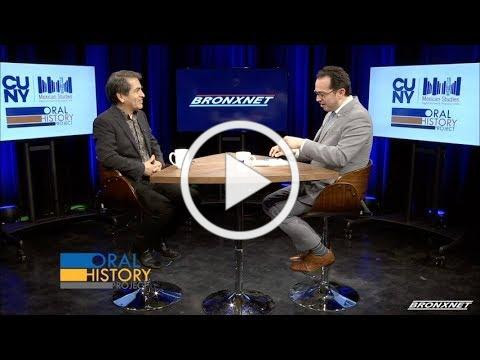
A complete interview by Bronxnet:
Mexican Studies Oral History Project: Felipe Galindo “Feggo”


Felipe Galindo (Feggo), 
Manhatitlan Codex, 2008, 5:30 min.


UT-Artist to Watch

Felipe Galindo(Feggo) - An Indescribable further turn way among us   


Felipe Galindo (aka Feggo)


Urban Tribes II-Urban Reverence (exhibition paused due to coronavirus)

Manhatitlan Codex, created by Felipe Galindo (Feggo), is a humorous digital animation, inspired by Aztec mythology and pre-Columbian codices, which narrates an imaginary migration of Mexicans to New York. It’s also informed by the voyage of the pilgrims in the Mayflower and historical human trafficking to America. 
Manhatitlan Codex explores the challenges related to the universal immigrant experience, such as impermanence, uncertainty and fragmentation, while at the same time presenting a witty and unusual look at this important issue.
"Manhatitlan Codex" by Felipe Gallindo (Feggo)
Felipe Galindo (Feggo),
Manhatitlan Codex,
2008, 5:30 min.
Reforming art and cultural activities to meet today’s needs can be a great way to promote harmony. TAAC's core commitment is through art to practice diversity, equality, and inclusion. Building bridges between communities, national and internationally through art and culture to deepen our senses of beauty, inspiration, and empathy.
By advancing these goals and building these bridges in the art world, we aim to promote a more just society. TAAC hopes that outrage will help to lead to a more equitable society, truer to our ideals.

New York artist Felipe Galindo, has dedicated himself to creating humorous art in a variety of media, including cartoons, illustrations, animations, fine art and public art. He is also an arts educator.
Many of Felipe's "It Used / Reused" ongoing series drawings remind of us pre-pandemic life and highlight the differences. the new life been giving to the used bag, cup and boxes the image that profile the continues living style in the city, while we are turned away from people by a lingering, invisible threat. Figures appear in parallel or in a semicircle or diagonally across from each other in the drawing's clustered space, the bodies either half-turned away from us, or shown in profile. These people do not wear face masks, but neither do they open the mouth; they rather fall into a friendly but silent atmosphere.

The TAAC team wishes you a safe time
When the conversation turned to the vague?
The drawings from the Used / Reused series have been compiled with Felipe Galindo‘s eye for reusing hang bags, train or bus tickets and subway maps, as well as paper cup and take out boxes. Preceding the pandemic, they nevertheless shed new slight on our new socially distant lives, as evidenced by the guarded conversation between figures in the drawings, figures scattered seemingly at random and placed unwillingly on the same plane. There is no tangible emotion or special anguish expressed by these people. In "Coffee Shops III-VI, they are situated behind and in front of counters that turn out to be familiar take-out cups unrolled in semicircular arcs in settings such as the cafes or bars where patrons play with cell phones or computers. Viewed in light of Covid-19, these scenes are reminiscent of one's affection for what has been cast off in these pandemic days. They are perfectly chosen for this moment. Paradoxically, we seem to be working and thinking disconnectedly in the virtual world in the midst of the virus. Imagine arranging in-person visits to museums, galleries,and auction houses to view original art works. Such actions have been abandoned and Feggo searches for a new folk song to reflect our altered realities. This year, we have had to turn away from the crowd in an immense grief for those lost. We have been admonished to disrupt the expectation of lip glamour in noisy conversation, the glass raised in toast, to public ecstasy in dinning. The subway crowds of various ethnicities, postures, actions, and expressions is a gift that no longer exists. Repelled by the absence of trivial daily details, we are isolated more and more from our own surroundings.
In these drawings by Feggo, the fragmented individual works boast no pompous air, but are defenseless to society's inflicted pain. Their characters swim in indifferent terms and ordinary features. However, they exhibit a remarkable organic and intuitive togetherness, a timely change from the sharp satire and the black humor that we have seen in Feggo's other animations and drawings. His drawings bear down on sepia -tinged photographs with an atmosphere of infinite poignancy, release a light sorrow, which is somehow still in harmony with the rest and produces a relaxed, warm, light attitude. It hangs on the act of observing, hence the amusing behavior induced in the spectators becomes an important but subtle component of this art.
--- Luchia Meihua Lee, curator
Mexican Studies Oral History Project: Felipe Galindo "Feggo"
A complete interview by Bronxnet:
Mexican Studies Oral History Project: Felipe Galindo “Feggo”
Felipe Galindo (aka Feggo)

Living and working in New York City, Felipe Galindo was born in Cuernavaca, Mexico. He earned a BFA in Visual Arts from the National Autonomous University of Mexico. His humorous drawings have appeared in The New Yorker, The New York Times, The Nation, The Manhattan Times, The Wall Street Journal, Reader's Digest, Mad, Narrative, NACLA, INXart.com, El Chamuco (Mexico) and numerous European publications (for example,The Spectat https://conta.cc/305TfmGor, Private Eye, Prospect and Oldie in England, Ode in Holland, International Herald Tribune, France; Red Bull F1 in Austria, Haüser in Germany.)
Felipe Galindo
Galindo has held numerous individual exhibitions in the United States and abroad.
Recent awards include: Ciudad de Las Ideas, Puebla, Mexico; Porto Cartoon Festival, Portugal; Aydin Dogan Success Award, Istanbul; Zagreb Cartoon, Croatia; Ministry of Tourism Cartoons Competition Award, Antalya, Turkey; The United Nations Ranan Lurie Political Cartoons; "People's Prize," Knokke-Heist Humorfest, Belgium; Greek Ministry of Culture Honorable Mention; "People's Choice Award," Omiya Festival, Japan. His books are: “Cats Will Be Cats” (Plume/Penguin), Manhatitlan (J. Pinto Books), “No Man Is a Desert Island” (J. Pinto Books), “George Washington: Back In New York City” (Now What Media).
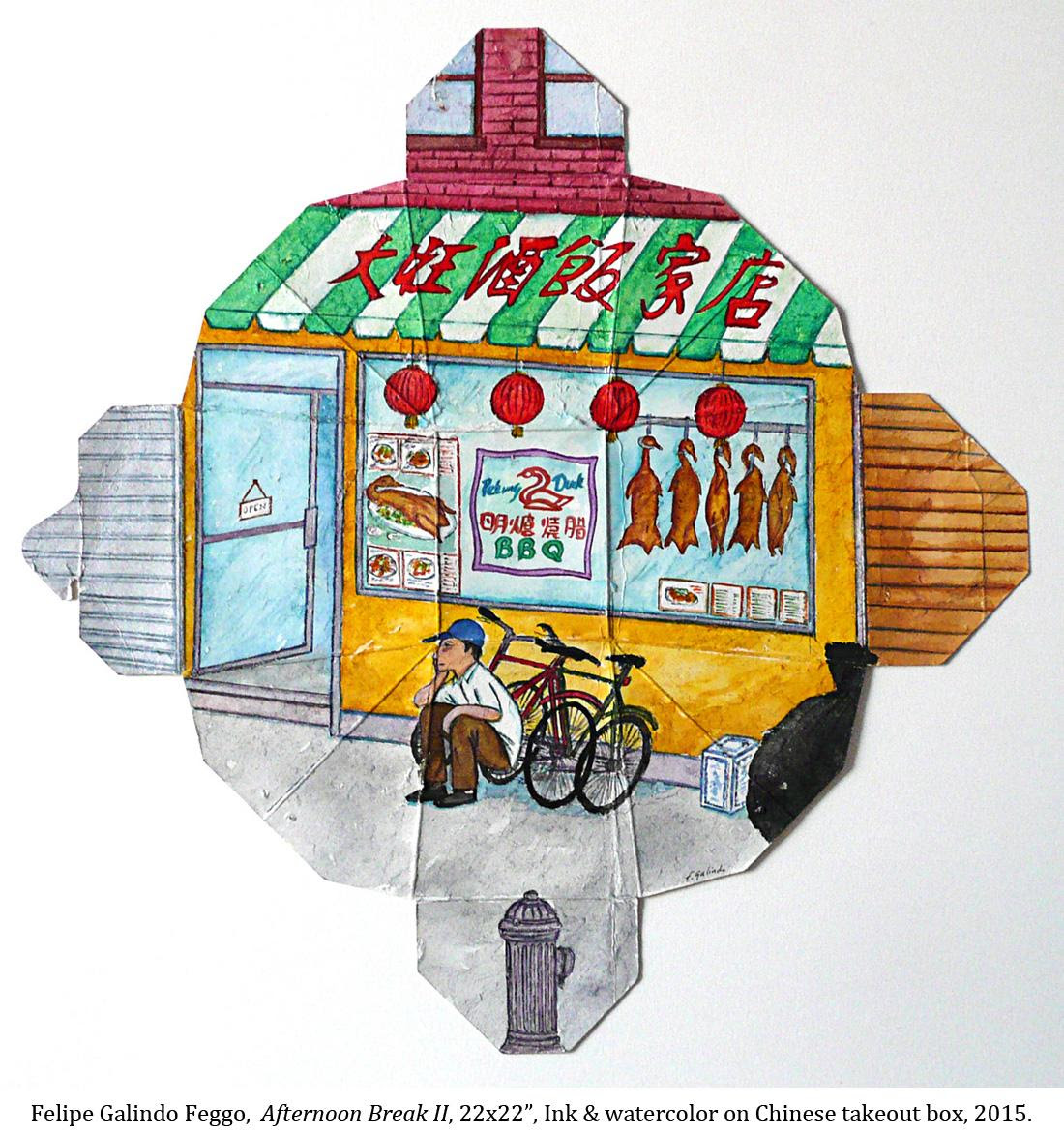
He has an ongoing series of works on disposable materials called “Used/Reused” in which he uses discarded materials to incorporate sketches of every day life in the city.
He created “Magic Realism in Kingsbridge,” a series of 4 permanent public artworks fabricated on glass based on Galindo’s humorous designs. They are installed at the 231st Street subway station platforms of the No. 1 subway line in New York City, commissioned by the MTA-Arts for Transit Program.

Statement by artist Felipe Galindo

Used / Reused
Drawings & Mixed media

I have been sketching scenes of New York City since my arrival from Mexico in the early 1980's. As I have walked its streets, enjoyed its parks, museums, coffee shops, riding the subway, buses, etc. I have tried to capture the nuances of the city and its human landscape with my pens and sketchbooks. If a subject fascinates me, I immediately try to capture the moment. This imagery on ephemeral materials offers my view on the everyday life of my adopted city. This particular presentation, of loosely drawn vignettes, contrasts with my more precisely rendered works of my other body of work of cartoons and illustrations.

Used / Reused is an on-going series of mixed media works inspired by the graphic qualities of packaging materials, in which I explore the possibilities of using disposable materials (paper bags, tin cans, boxes, coffee cups, maps, etc.) as physical support for sketched drawings, to make visual commentaries, superimposed on familiar objects we use, take for granted and discard continually. I intend to give new life to these disposable materials, and at the same time, a different one to my drawings. 
How ancient art influenced modern art - Felipe Galindo

Mexican Studies Oral History Project: Felipe Galindo “Feggo”

Friday, July 3, 2020

Shida Kuo 郭旭達-The Still, Protruding Moment

Do we practice alteri (altruism) and do we protrude into the still?

by Luchia Meihua Lee, curator

Shida Kuo , living and working in New York City, has dedicated himself to sculpture in ceramic and to two dimensional works in various media for decades. Shida Kuo's gentle earth-ware, frequently augmented by a protuberance, contains elements of warm simplicity while the appendage is shy or modest yet alluring or even lyrical. We would like you to appreciate these exquisite art works. In the pandemic during the limited travel period, he has managed to have a solo exhibition in Taipei. As is widely known, Taiwan had done an excellent job of controlling the virus, so galleries and museums did not close there.


Shida Kuo‘ s ceramic sculpture, and other two dimensional art works are each unique, all of them being reticent, organic and displaying a geometric form. What strikes viewers is that the work is simultaneously powerful yet reserved. The smooth body part exerts a force conditioned by the protrusion which is somehow still in harmony with the rest of the work. The total effect is not austere but reminds us of Kuo's own warm, witty, gentle manner and attitude. The work's very form conveys action, or even antics, that hang on the act of observing, so the viewer's reaction to the art has both outward and an inward components. Hence the amusing behavior induced in the spectators becomes an important but subtle component of any exhibition of this art - in addition to its careful, delicate, ordering, organic beauty.

In looking over these works which echo and complement each other, one recognizes same delicate identical structure of a sluggish pulling of an extrusive part, which is joined in mutual deceit; the pulling away intimating a threat and a moving away from the larger part.
In some cases, a deep recess is filled with paint white, while the projecting part is painted a dark tone and may evoke either nipples or phalluses. Those rest in the confidence that might be self sufficiency. in lyric moods of exaggerated, self advertising.


Artist to Watch
https://conta.cc/2BBbp66  

Shida Kuo 郭旭達
The Still, Protruding Moment

R eforming art and cultural activities to meet today’s needs can be a great way to promote harmony. TAAC's core commitment is through art to practice diversity, equality, and inclusion. By advancing them in the art world, we aim to promote a more just society. TAAC hopes that outrage will help to lead to a more equitable society, truer to our ideals.

In this ATW issue, we have NY artist Shida Kuo 's untitled pieces. And don't forget to listen to and watch the music of Taiwanese band The Chairman as they play Sacrifice to Welcome the Gods.

Happy July 4th!
The TAAC team wishes you a safe time

Shida Kuo , living and working in New York City, has dedicated himself to sculpture in ceramic and to two dimensional works in various media for decades. Shida Kuo's gentle earth-ware, frequently augmented by a protuberance, contains elements of warm simplicity while the appendage is shy or modest yet alluring or even lyrical. We would like you to appreciate these exquisite art works. In the pandemic during the limited travel period, he has managed to have a solo exhibition in Taipei. As is widely known, Taiwan had done an excellent job of controlling the virus, so galleries and museums did not close there.
Do we practice alteri (altruism) and do we protrude into the still?

Shida Kuo‘ s ceramic sculpture, and other two dimensional art works are each unique, all of them being reticent, organic and displaying a geometric form. What strikes viewers is that the work is simultaneously powerful yet reserved. The smooth body part exerts a force conditioned by the protrusion which is somehow still in harmony with the rest of the work. The total effect is not austere but reminds us of Kuo's own warm, witty, gentle manner and attitude. The work's very form conveys action, or even antics, that hang on the act of observing, so the viewer's reaction to the art has both outward and an inward components. Hence the amusing behavior induced in the spectators becomes an important but subtle component of any exhibition of this art - in addition to its careful, delicate, ordering, organic beauty.
In looking over these works which echo and complement each other, one recognizes same delicate identical structure of a sluggish pulling of an extrusive part, which is joined in mutual deceit; the pulling away intimating a threat and a moving away from the larger part.
In some cases, a deep recess is filled with paint white, while the projecting part is painted a dark tone and may evoke either nipples or phalluses. Those rest in the confidence that might be self sufficiency. in lyric moods of exaggerated, self advertising.
- Luchia Meihua Lee, curator
Shida Kuo is a Taiwanese-born sculptor living and working in New York City. He holds a B.F.A. in Painting from National Taiwan Normal University (Taipei, Taiwan) and a M.A. in Studio Art on Ceramic Sculpture from New York University. He
has taught in the Department of Art and Art Professions at
New York University since 1993. His sculptures and paintings have been in numerous
national and international exhibitions , most recently at Eslite Gallery in Taipei.
Statement by Shida Kuo

It puzzles me why certain forms and some particular types of material always possess more visceral power over me than others. Similarly, I am curious how people of different origins and backgrounds respond to forms and materials in an identical way. Is that an evidence of homogeneity of mankind as a collective species? It seems to me that those shared experiences of emotional and spiritual impacts created by forms and materials have been articulated by our bodies even before they could be understood by our minds. It is a collective sense of deja vu for mankind, repressed by consciousness but persistent in our veins. Drawing was the primary method of communication before the invention of languages. Wasn’t drawing initially based on observations of the nature? What was the process, then, in which nature was transformed into shapes and lines?
I am driven by these related questions, and cannot help trying different angles when approaching those natural creations. I attempt to locate the essence of forms, as a whole or as configurations of fragments. Those fragmented, unfinished forms are stored in my head, waiting to spring up from the entity called “I” after a series of conflicts, contradictions and convergence among themselves, until they emerge as a new form of completeness.
My work from the past years demonstrates this creative process. Instead of making any statement through my work, I have played a faithful recorder, using only my sensitivity to materials and undisguised techniques, just to catch the forms that might have been otherwise left in oblivion.
I use primarily ceramic and wood for my work because human beings have used these two materials for thousands of years regardless of cultural or racial differences. They are close to us in many ways and thus are the best material for me to convey my ideas.
Shida Kuo's Story | Sculptor
Current Exhibition:
Shida Kuo: Un/Form, De/Intellectualize
郭旭達:離形去知
■exhibition at the Eslite Galler y, Taipei, Taiwan
(誠品畫廊)
■from June 06 to July 26, 2020
趙琍談郭旭達 https://youtu.be/oSBER-MmA98

More information: Shida Kuo
Portfolio website:
youtube:
https://youtu.be/84UbAcA3hiw

TAAC -- Building bridges between communities, national and internationally through art and culture to deepen our senses of beauty, inspiration, and empathy.
This is a critically important time for us, and we’re hoping to reach our partners to help us continue in our mission of presenting art in a new perspective. To donate to TAAC, click our website, and locate the DONATE icon.

Exhibition: Urban Reverence, New York  (paused due to coronavirus)
The phenomenon of migrants forming an international cross-cultural "urban tribe" is one of the urgent topics in the 21st century. Analyzed historically in the context of the planet and symbiosis, this involves the survival of human beings and maintenance of balance among various living things. The discourse thus moves to valuing human nature, preservation of multiple cultures, the environment, and the new multi-faceted unity. Potential political, economic, and cultural crises can only be averted by an emphasis on the diversity of life that promotes interactive relationships.

Curatorial team:
Chief Curator: Luchia Meihua Lee, Executive Director, TAAC
Co-curators: Jennifer Pliego, Director of Special Programs and Head of the House of Art, El Taller Latino Americano, NYC
Sarah Walko, Curator, Director of Education & Community Engagement, Visual Art Center of New Jersey
[Image courtesy of artist
Alexander Khimushin]
[Image courtesy of artist
Herberto Turizzo Anaya]
[Image courtesy of artist
Wei Lee]
[Image courtesy of artist
Sarah Walko]
[Image Courtesy of artist
j. maya luz]
[Image Courtesy of artist
Yeh Fang]
Reinhard Blank
Current exhibition AusZeit : Kunst als Klärung at Stadtmuseum Memmingen (德國梅明根市立博物館) The exhibition lasts until January 24, 2021
"Sacrifice to Welcome the Gods" 【 music by The Chairman Band 】

Music from a Taiwan temple festival to gain the blessing of the God. The video starts by listing each month's festival - for instance, May (the fifth month of the lunar calendar) contains the Duanwu (dragon festival) - followed by an introduction to the legend of Matsu (a sea goddess). Matsu's festival  is a major event in Taiwan, with the largest celebrations around her temples. The Chairman Band is a popular rock band in Taiwan; they have won several Golden Melody awards. Formed in 1997, The Chairman Band combines elements of traditional Taiwanese culture with Hokkien lyrics.
from Album: 祭
Licensed to YouTube by Rock Mobile Corporation (on behalf of 武藝音樂有限公司), and 2 Music Rights Societies
https://youtu.be/toQlDlv7DVI
董事長樂團 - 迎神 Sacrifice to Welcome the Gods【 The Chairman Official Music Video 】