Thursday, June 23, 2022

Tuesday, June 21, 2022
From Urban Reverence to Urban Divergence exhibition : venue 1- Pfizer

The centrifugal tendency in the transition from the rural village to the urban is the loss of cultural rituals and myths, the need to adapt to the new language and the loss of innocence. Art creators are able to mediate and textualize new connections to the threat to culture and most particularly its antecedents.
The series of Urban
Tribes projects started in 2018 to examine from an art perspective the
phenomenon of migrants forming an international cross-cultural "urban
tribe" – one of the genres at the turn of the 21st century. The discourse
thus moves to valuing human nature, preserving multiple cultures, renewing the
environment, and honoring the new multi-faceted unity. Potential political,
economic, and cultural crises can be averted only by an emphasis on the
diversity of life that promotes interactive relationships.
Luchia Meihua Lee
co-curators: Jennifer Pliego, Sarah Walko
Participating artists:
1.
Herberto Turizzo
Anaya
v
Exhibition
dates: June 10 through July 23, 2022
v Exhibition venues 1:
1st Floor, IW Art Gallery
5th Floor, old Pfizer
building, 630 Flushing Ave, Brooklyn, NY 11206
v Satellite exhibition:
· Exhibition dates: June 24 through July 23, 2022
· Exhibition venue 2: Valerie Goodman gallery, 315 E 91st St, New York, NY 10128
Thursday, April 21, 2022
Smooth the image of the world : Wu Lan-Chiann
Wu Lan-Chiann:
Smooth the image of the world
by Luchia Meihua Lee
In these past few years, horror and delight have alternated, and swelling painfulness has tested our endurance. Perhaps we haven't changed enough to ameliorate the inequities in many social subjects. In Wu’s art work, we find a view of a world not ordinarily seen, an alternative to the endless violence of our time space. Her extraordinary paintings possess a mythical quality and profoundly touch the core value of nature that is missing from urban life, and function as a salve beyond the material world.
Born and raised in Taiwan, Wu lives and works
in Los Angeles. She holds an MA from New York University’s Fine Art Department.
Cross-cultural fusion has operated remarkably in her art to form a sensuous,
organic, sleek and hermetically wider embrace as a contemporary Asian women
artist.
Lucy R. Lippard" mentioned in 1975 "It is no coincidence that the women artists’ movement emerged in a time of political travail and political consciousness," 2 also pointing out the emphasis by the women’s movement on social structures that have oppressed women. In this vein, I identify this Taiwanese American woman artist, Wu Lan-Chiann as a minority's minority immigrant in US society. This is not an attempt to create distance from the official ideological universe about the patriarchal hegemony, but to lay emphasis on national identity among Taiwanese-Americans.3 However, Wu has also averred with Lippard that these social movements can provide heightened awareness of the multi-cultural model, which "could indicate a way to move back toward a more basic contact between artist and real life.”4
Wu’s art is notable for a certain veracity resulting from the "deliberate modesty of format [and] displacement of literary sensibility into the fabric of the visual."5 I eschew an intellectual statement about female artists in general, while trying to make sense or identify sources that communicate with Wu's statement and experience, and thus follow her emotionally. When we embrace art by a woman, we too often celebrate delicacy, elegance, and softness. Thus, we can acknowledge the uniqueness of this great visual representative imagery.
Her work is subtle in its details and tactile in its veiled-like application. Upon first impression, the strength of Wu's painting is its connection with traditional brush ink painting. I do not intend to examine the nature of her precedents, but underline the way in which she has modernized and advanced the brush ink tradition. Wu has not only chosen entirely different subjects than classical shan shui (literally, "Mountain and water" which means landscape) exponents,6 but also given an entirely different treatment of light.
I have found undeniable pleasure in these paintings’ visual expression, from the pictorial techniques to the aesthetics and philosophy. In her Precious Light series, one can easily find the commitment to smooth muscle base. Cursory inspection might deem these paintings flat, but further study reveals subtle colors and application of foggy gradients. Sometimes jet black in blurred light, they strongly develop a quiet depth of harmonic power in the dark night.
In Perseverance, one’s gaze is directed to the tree’s vigorous bark recalling a snake skin, around which interlocking pine needle-laden branches stagger. In traditional Chinese brush ink painting of pine trees, the artist aims not for a realistic effect but a symbolic representation of the independent stance of the literati. So Wu’s detailed rendering of the bark of her pine tree underlines the freshness of her approach, and a reorientation of the pine’s significance.
The nature landscapes display a type of rhythm which seems discordant but not struggling. They are the basis on which she seeks to transcend cultural boundaries and create a timeless commentary on humanity. Wu believes in her art’s power to heal and unite, to express universal humanistic values through and her core conviction that we are one people.
The artist writes that, "art speaks a universal language that people understand across time and place. People enter this world defenseless and curious, share the same hopes and fears, act out of kindness or spite, and go through the same stages of sorrow and grief. "
The
evergreen nature of pine trees is a symbol of longevity and perseverance in
Chinese culture.
Wu
painted Perseverance in response to the global pandemic; while
people around the world long for life to return to normal, it takes real
perseverance to wait for that day. Perseverance is an innate human strength
that Is evident only in difficult and challenge times.
______________________________________
1. Hay, J. "Mu Xin and Twentieth-Century Painting", The Art of Mu Xin: Landscape Paintings and Prison Notes. Yale University Gallery, 2001. pp. 28-39.
2. Lippard L.R. "The Women artist' movement-What next? The pink Glass Swan, The New Press, 1995. pg.81.
3. Salecl R. "National Identity and Socialist Moral Majority", New Formations. Routledge, 1990. pg. 25-31. I have tried to avoid simple criticism of the nationalism of Chinese in PRC, but this essay about the opposition moral majorities and authoritarian-populist Communist parties which "have built their power by creating specific fantasies of a threat to the nation and so put themselves forward as the protector of 'what is in us more than ourselves - our being part of the nation.' This analysis applies exactly to the record of the Chinese Communist Party, which has relentlessly and radically assaulted all traditional points of social identification, leaving a chauvinistic nationalism intertwined with support for the party and identifying all foreigners as the feared "Other" as the only remaining public fantasy available to the Chinese.
4. ibis. Lippard L.R. pg. 81.
5. ibis. Hay, J. pg. 36.
6. Lee, L. & Sibergale, J. Zhang Hongtu: Expending Visions of a Shrinking World, Duke University Press. 2015. pg. 160.
7. Lee, L. Meditation in Contemporary Chinese Landscape, 2008 Godwin-Ternbach Museum, Queens College, CUNY
Saturday, March 27, 2021
Reinhard Blank
The Substance of Balance in Implicit Strength
by Luchia Meihua Lee

 |
| Connection of sky and earth, an invited design; 2014; Cement, granite, water ; 177.2 x 70.9 x 13.8 inches; photo credit Florian Holzherr. |
 |
| Sky Mirror, 2007, Steel, granite, water, 138 x 81 x 18 inches. Private collection |
From Blank's statement, we learn his work not only aspires to a type of "reductive art" or minimal aesthetic but also an exposure of means. 'You see not only "what you see" ... but how [it] got there, in the normally regular but nuanced not (melo)dramatically but subtly expressive, wake of the brush.' [3] Blank expresses purity in his works and has a precise grasp of the subtleties of three-dimensional shape. This is apparent in his flat paintings. Minimalists choose to let the art object present its own characteristics.
The essential composition shows the geometry of Blank's work and is more like Bauhaus's ingenious design and follows his literacy of the void, where solidity and emptiness are interlaced and complementary. In his sculpture, Blank uses steel and water to represent contrasting states constrained in time and space with mathematical rigor. "Natural philosophy" refers to the drive to draw moral and spiritual wisdom from God's creation. This natural philosophy embraces the over-arching languages of mathematics and theology and bends human invention to decipher appearance and the invisible. It has no restriction and harmonizes thought of such diverse thinkers as Aristotle, Thomas Aquinas, Erasmus, Isidore of Seville, and later Isaac Newton.
One of Blank's landscape sculptures, Sky Mirror, was commissioned for a garden and combines small ponds , water and steel into sculpture. Thus natural landscapes are contained in and complemented by soothing minimalism. The structure, is in perfect harmony with the garden, dialoguing with its numerous rare flowers and plants. Another imaginative use of reflection may be found in one of his church door designs where glass in a small cross reflects the grassy area in front of the church. Elegant and carefully calculated composition in steel and flowing water can be found in many of his sculpture pieces. In Sky Mirror, the variation in the flow of water, and consequently in the configuration of the water surface, induces a corresponding change in the reflection of the sky and the ambient light, which is particularly mesmerizing. The work catches and re-radiates the changing mood in the nature environment and the passage of the seasons, and even in its stillness is dynamic.


 |
| [3 images above: Invited design of the Dr. med. Weidlich medical hospital, include the outdoor entrance, and interior wall pieces.] |
W. J. T. Mitchell [5] delves into the relation between word
and image. While the former is the traditional domain of art history, if “art
history aims to become a critical discipline, one that reflects on its own
premises and practices,” then it must draw inspiration from and utilize the
tools of semiotics, structural linguistics, grammatology, discourse analysis,
rhetoric – and yes, even philosophy. Blank’s unique blend of minimalism,
design, mathematics, and philosophies both Eastern and Western, is an example
par excellence of art that demands to be analyzed in Mitchell’s terms – to be
appreciated on a purely visual level, but then more fully contextualized.
[1] Seb Falk, The Light Age: the Surprising Story of Medieval Science, WW. Norton & Company, 2020, p.4.
[2] ibid., p 5.
[3] Edward Strickland, 'Paint", Minimalism: Origins , Indiana University Press, 1993. p. 110.
[4] Gregory Battcock, Minimal Art: A Critical Anthology , University of California Press, 1995. p.181-185, p. 260-262
[5] Critical Terms in Art History , Nelson and Shiff, eds. University of Chicago Press, 1996, P 48.
David Elliot, Making Sense of Things, ed. Carin Kuoni, Words of Wisdom, Independent Curators International (ICI), NY. 2001.
Artist Statement
What I am looking for is the simplest forms to comprehend the world. I dedicated most of my time and energy to philosophy. Inspired by artist Piet Mondrian, art historian Hans Joachim Albrecht, and influenced by ‘Structures and Dynamics of Theories’ of Wolfgang Stegmüller, I transformed my artwork toward rational and conceptual expression by means of geometric structures. Lacking ornamentation, radically simplified geometric forms are grounded in Earth symbolism and demonstrate my concerns with the world, the body, the mind, and the spirit. I use a rational structure design result correlating width, length, area, volume, proportion, space, the mass, weight, and Fibonacci sequence to promote an aesthetic view and effect, and also respond to visual interpretation with implicit and metaphorical statements in a systematic style. My artwork is a product of a specific focus on the world that we live in and serves as a mirror for ourselves. At the beginning, we are embedded in a predetermined but unforeseeable background; however, continued and inevitable interactions reformat and re-shape us. In my artwork, I try to develop a harmonious, meditative character that promotes contemplation of both the rationality of the human intellect and its limitations. This reveals my innermost concern with consciousness – a seemingly comprehensible, mechanical structure, modified by a transcendence beyond the limits of rationality and hence unknowable.
- Artist Reinhard Blank web page https://reinhard-blank.de/
- The Substance of Balance in Implicit Strength https://conta.cc/3lSYcZk (of Constant Contact e-blast page)
- Reinhard Blank 的後花園小屋雕塑- 揭秘這一位德國巴伐利亞的小鎮藝術家
https://ll-greenyes.blogspot.com/2019/01/reinhards-spiritual-garden-bad.html
- Art as Implicit Substance 存在中的真實
https://ll-greenyes.blogspot.com/2019/08/reinhard-blank-art-as-implicit-substance.html
- Reinhard Blank: Venice 2019 exhibition preview video link:
https://youtu.be/CumOffw0M28
- Reinhard Blank “AusZeit - Art as Clarification, Stadtmuseum Memmingen ( to view Reinhard Blank “AusZeit - Art as Clarification at The Memmingen City Museum)
https://zeitmaschine-stadtmuseum-mm.de/de/ausstellungen/sonderausstellungen
- 德國巴伐利亞地區梅明根市-田園詩般的工業小城 Memmingen, Germany
https://ll-greenyes.blogspot.com/2013/09/memmingen-germany.html
More Reinhard Blank art work images to view:
 |
| Entrance to Church of Saint Martin in Memmingen, Germany, 2017. Glass and steel, 134 x 102 inches, photo credit Andreas Marx |
 | ||
| Shadow of the Mind; 2007, Steel, Japanese paper, glass, 20.5 x 16.5 x 5 inches/each |
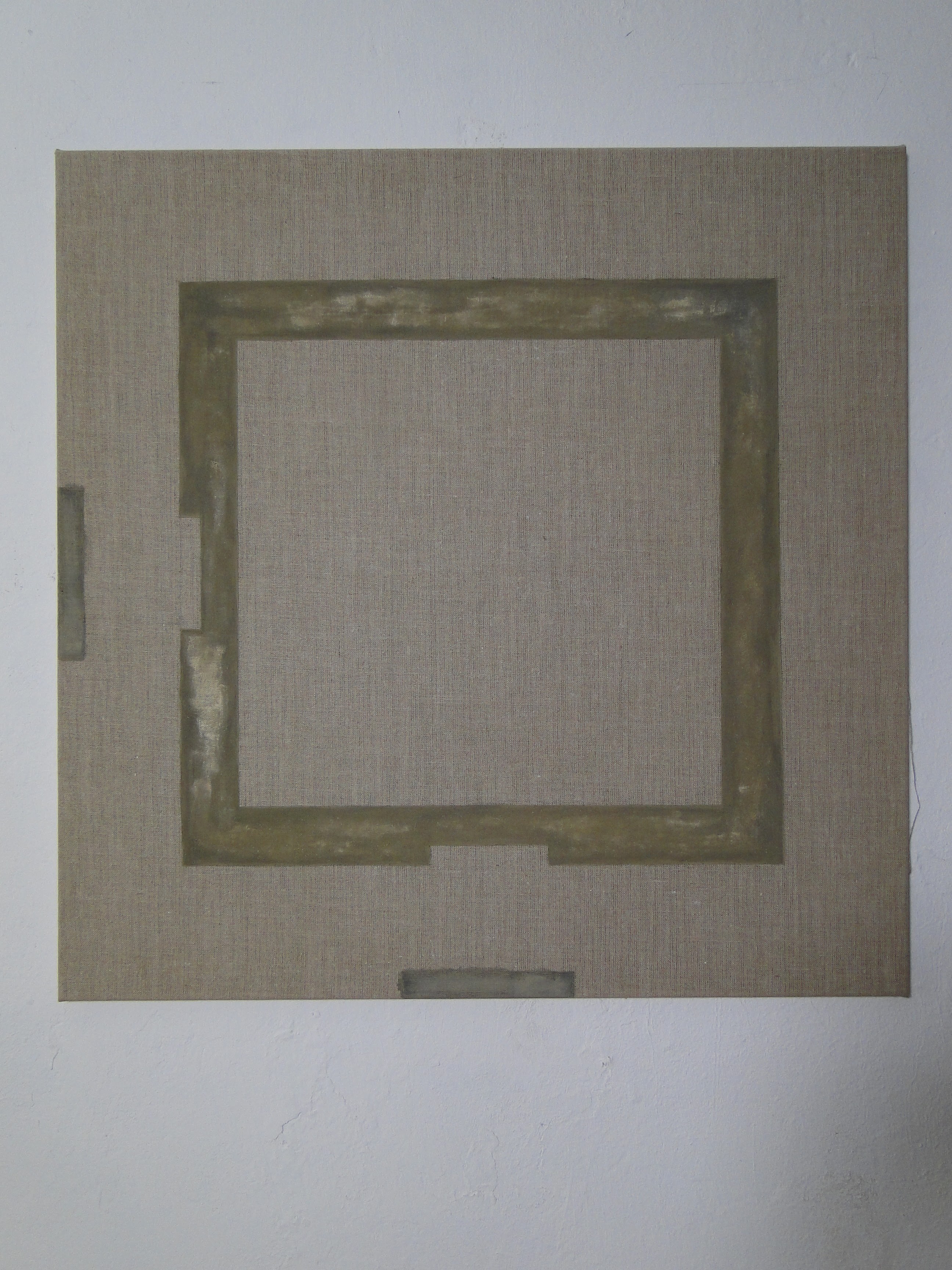 | |||||
| Introspection, 2015, Pigment on canvas, 21.5 x 21.5 inches. |
 | Twelve Apostles; Steel, copper, and glass; invited design of the main door of church Kinderlehrkirche, 2011 built in Memmingen, Germany | |
 |
| Interaction - Minimalsystem der Selbstreferenz III; 2004, Steel, 64 x 64 x 45.7 inches. The crumbling surface of the metal can be seen via time lapse photography. |
 | |||
| Sky Mirror, 2007, Steel, granite, water; 138 x 81 x 18 inches. | Private collection. | |
 | ||
Śūnyatā" Fountain; an invited design for the garden of a yoga practitioner , 2010, Cement, 39.4 x 47.2 (diameter) inches. Śūnyatā (Sanskrit) is a Buddhist concept often construed as emptiness and sometimes voidness. |
Reinhard Blank , Born in Memmingen, Germany.MFA (master class diploma), The Academy of Fine Arts, Munich , Germany
Selected Awards / Honors
- Arts Prize of City Memmingen (Kulturpreis der Stadt Memmingen), Germany.
- Special Artist Prize (‘Künstlersonderpreis’), Künstlerhaus, Marktoberdorf, Germany.
- Artwork - Raum Skulpturen ‘Garten der vier Eletmente‘ selected in publication, as one of the model and architectural inspiration in the Allgau region during 2013-2018 by Architektforum e.V. , a selection once in five years, reviewed by an international panel of professional architects.
Selected Solo Exhibitions
- Visual Structure Theory -Tractatus of Ludwig Wittgensteins, associated with a lecture ‘how to reconstruct Wolfgang Stegmüller’s Interpretation of Tractatus, a theoretical model of Ludwig Wittgenstein’s in a visual form’, University Ulm, Germany.
- ‘Aesthetics of Void’, Kreuzherrnsaal, Memmingen, Germany.
- ‘Poesie der Unterscheidung’, Schloss Hohlenheim, Stuttgart, Germany.
Selected Group Exhibitions
- "experiment konkret - Eugen Komringer zum 80.", Museum für Konkrete Kunst, Ingolstadt, Germany.
- “Sammlerkonzepte“, Kunstspeicher Museum, Würzburg, Germany.
- Anniversary Exhibition, Künstlerhaus, Marktoberdorf, Germany.Selected Public Art/Design
- ‘Interpretation from Trinity with “Minimalsystemen der Selbstreferenz”’ Ceiling Design –(size 99 m²)., Trinity Church (Dreifaltigkeitskirche), Ravensburg, Germany .
- Corridor and Worship Room Design for Arche Slowenien, Medvode Slowenien.
- Invited design of the entrance and souvenir area of St. Martin's church, Memmingen, Germany.
Selected Collections
- Municipal cultural department, Memmingen, Germany.
- Municipal cultural department, Kempten, Germany.
- DG-Bank, Hohenkammer, Germany.
- Selected Publications
- Minimalsystem der Selbstreferenz. Malerei im interkulturellen Dialog, Gallery Akzente 2001, Memmingen, Germany.
- essay – Teezeremonie und Spiritueller Raum - Überlegungen zu Wahrnehmungsformen von Transzendenz, published in Journal ‚Spiritual Care‘ volume 8(1) 2019, p. 67-75, DE GRUYTER, Germany.
- essay – Ent-täuschung – Spiritualität in book “ Spirituelle Erfahrung in philosophischer Perspektive”, p. 161-167, Walter de Gruyter Berlin, Germany.
Teaching
- 1991 - 1998 P rincipal of School 'Schule für Gestaltung', Teaching ‘philosophy of fine art,’ Ravensburg, Germany.
Contact artist:
Reinhard Blank
Thalatelier Reinhard Blank, Unterthal 33a, 88730 Bad Grönenbach -Thal Germany
email: info@reinhard-blank.de
Thursday, December 3, 2020
Yen-Hua Lee : Value and Appearance of Observing Silence
Value and Appearance of Observing Silence
"Rather than love, than money, than fame, give me truth." ― Henry David Thoreau (1817-1862)
 |
Tomorrowland, ballpoint pen
ink on book page, 8 1/4 x 6 3/4 in., 2014~2019. From the Book project series, Courtesy of the artist |
For a stylistic analysis and iconographic interpretation, I have placed Lee’s art in the cultural realm of anthropology, and more particularly in a home/family context where it participates in visual communication. Her artistic treatment and transformation of the human figure leads to images that resemble low-relief carvings and finely incised scenes.
The shape of the figures and the outer contour of the face are echoed in a series of concentric edges which radiate outward from the center; the lower edge of images depicts a single ground line. While detail has been eliminated and narrative abridged or at least channeled, this works to highlight a lively shape and imperative body gestures. The group of works are identified as forming a system of visual contemplation.
Lee remarks "I want to take a deep breath in the country of freedom. In the country of freedom, I want to escape the embarrassment of real society. In the country of freedom, I want to find the person I want to be. Is it okay? Is it really possible? Yes, just be the original you." [2]
In her Home series, Lee stacks the memories of life, discovers the rituals of life, and develops the inner energy. She roots the work in a concept of "home" as people seeking a space in which the soul should not be afraid and not be lonely. Therefore, when the audience walks up to the piece that she constructed, it can experience, in both body and mind simultaneously, a calm, inward space.
 |
Home project (2012~Now) , Searching for spiritual home series (Berkeley and San Francisco), dimensions variable, Courtesy of the artist. Home is a place of spiritual and physical protection. People have always wanted to know how to establish a harmonious home, but the search invariably involves a long, drawn-out process with its own memories of time that force us to reconsider the relationship between people and home. |
For her “Book project,” Lee chooses books by authors from past ages. What she is curious about is how books communicate with people today after a considerable time has passed since they were written. She accords priority to a type of "linear reading", which is through the image, lines, and light with wind to arrange a space that can dialogue with viewers. When the wind blows the pages, they are opened for reading, and a societal phenomenon and value viewpoint is released. She makes full use of visual symbols appended to the texts in parallel to the contents. When we open the book page, it shows mirror reflections corresponding each to the other. In some works she uses both Chinese and English language books to create a conversation. Most of her works present images that carry a concept of “time” and “memory”. When we turn the page, it is similar to opening a memory.
The works in the Search for spiritual home series, often grotesque in appearance, seem to represent a shaman’s power spirit. There is no decoration, but a strong symbolic indication of ritual, emblem, and a secret society inhabited by spirits. The anthropomorphic figures on the wall seem to be a mixture of human and effigy serving as ceremonial symbols.
The light background color creates a negative form next to the figure pattern. As has been remarked in another context, “sometimes this negative form can be read as a positive form creating an ambiguity between figure and ground. This reversal of figure and background is common in Kwakiutl art.” [3] Ritual, although sometimes irrational, affords security and provides an order to the chaos of life. We may say "in visual arts, rituals also surround each work, marking key points in the creative process, as well as in its exhibition, viewing, and discourses on signification." [4] One might say that Lee invented a ritual: reading as a means of remembering. Lee constantly uses signifiers to construct her work and extend the viewer's imagination. We find many shapes - from houses to bottles - in her works to project the idea of containers that can protect our existence, provide a healing place and power of story transferred. The rice paper she likes to use is very thin, fragile, and easily damaged - and thus a perceptive metaphor for our lives. Further, making art with such delicate materials requires slow deliberation and careful attention to detail, as does living daily life. In this way, value and appearance resonate one with the other.
Her installations are site-specific works that change the space to a transition of mind and home. She combines clues, beams, energy, light and shadow, and connections, and also guides the audience to watch and find directions. Lee emphasizes the connections between history and memory of the location that could be your village, community or city. The line is an element that allows the artist to connect the history and memory of her audience with herself. This line constitutes the form and the past of the previous "home”. In terms of structure, it shares an awareness with architecture, and she also hopes to use these clues to make people explore the past, and then to further look at the relationship between her inner home and the creative home.[5]

Lee said her work is inspired by calligraphy, indigenous culture, and
ceramics. Her flat black silhouette painting style has the feeling of thick
calligraphy. The sculptural nature of pottery and porcelain makes her thinking
more three-dimensional, an outlook seen notably on a series of outdoor
billboards. The visual images, inseparable from her signature black symbols,
are the conduits and reflections of her artistic intuition. Rising directly
from her unconscious, they are thus internalized into a kind of insight and
presented.
What is "reasonable" and "normal" in our society is not necessary so in another. [6]"A means of heightening the difference between "ordinary" and the "strange" ,....related contradictions serves as an important impetus for artistic expression with artists seeking to create a sense of order (rationally, logically) out of conditions characterized more generally by features of confusion and contradiction."[7]
Lee writes words on the book-thick pages to express emotional communication with the author's work. In her view, the book carries the meaning of words, yet also the content and memories of the times. Reading is a mode and behavior of people's seeing. Through reading and paper transmission, people's stories and memories are evoked. The memory presented by humans is like the missing page. Through the visual reading of the artist exploring the extension of the paper after flipping, the audience creates visual language between viewing and staying between pages, and new content and multi-layered meanings are generated through time interlacing.
While Lee's art employs a discourse on allegorical and spiritual
interpretations to reveal a hidden meaning for modernity, the line-connected
symbols must be carefully interpreted to avoid being "conceived as
antithetical to the modernist credo Ill faut etre de son temps." [8].
She courageously transforms the most subjective to a objective
expression in which the verbal is expressed as visual.
 |
Right: Packaging, Ink on book page, 7 1/2 x 10 in., 2014~2019, Courtesy of the artist |
 |
Left: Boat and bike, ballpoint pen ink on book page, 7 1/2 x10 in., 2014~2019, Courtesy of the artist |

 |
| Book project series, ink on book page, 7 1/2 x10 in, 2014-2019 Courtesy of the artist |
Friday, October 16, 2020
Hiroshi Jashiki: From Okinawa to Central Park
From Okinawa to Central Park
"... a world without art and happiness resembles a
nursery without laughter." - Hendrik Van Loon (1882-1944)
In this ATW, I would like to bring your attention to a unique artist from Okinawa, next door to Taiwan in the first island chain.


From Okinawa to Central Park
Okinawan treasures include exquisite handcrafted textiles,
amazing ceramics, heart-touching sanshin melodies, and shisas (lion guardians).
All the historical splendor and local culture mingle with the contemporary
sense which has already moved into original daily gourmet food. The landscape -
from sand to mountains - is never far removed from the dominant influence of
the sea.
Hiroshi Jashiki lives and works in New York, although he was
born and grew up in Okinawa, Japan. He uses imagery from many sources but
especially from Okinawa and New York City. Because of his use of textile
software technologies and carefully controlled color and composition, the
original photographs from which he starts are no longer visible at the finished
stage. Influenced both by Okinawa native hand weaving and modern digital
textile design methods, "Jashiki takes his inspiration from nature. The
colors he uses for dyes are sophisticated and delicate, giving his work a minimal
sparseness that at the same time is dreamy." [2] image:
"The foundation of Jashiki's career was the indigenous,
skilled hand weaving which he encountered on the Okinawan islands. His horizons
were expanded first by formally studying art and then by embarking on a career
in the New York fashion industry as a textile designer." [3.]
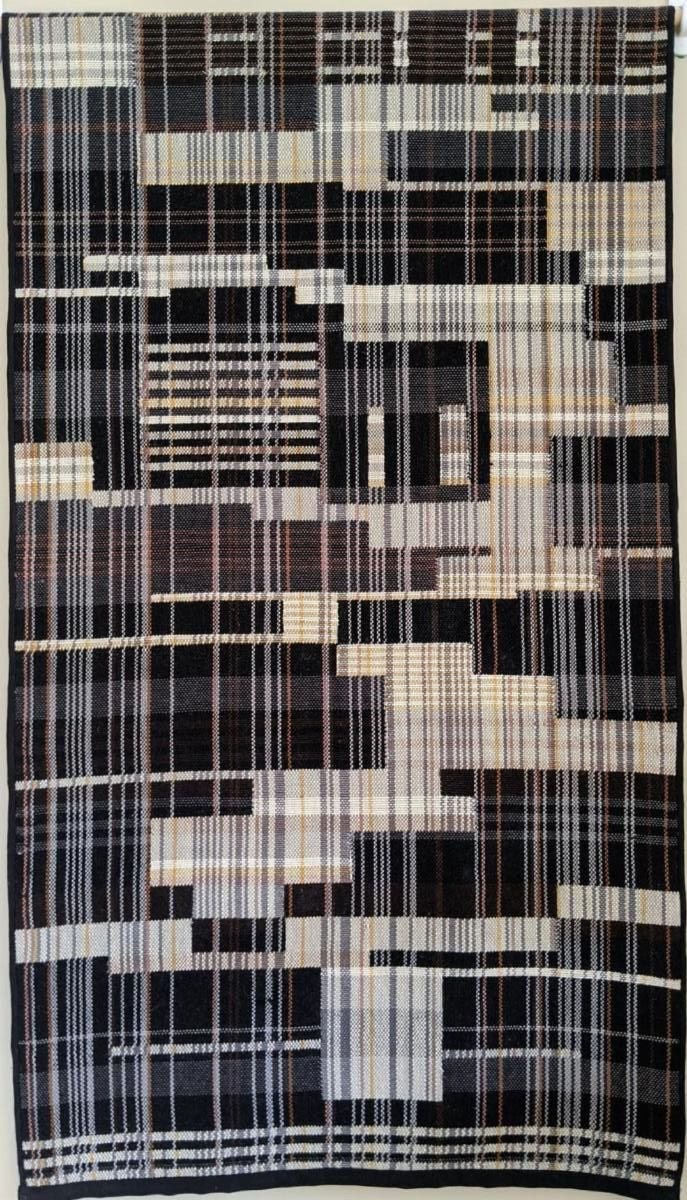
Jashiki comments: "Kasuri is a weaving technique. It
basically is a yarn dye tie-dye (warp and weft yarns are tie-dyed beforehand)
weaving. It is also known as "Ikat". What makes Okinawan Kasuri
unique is its geometric patterns. I fell in love with it when I took a weaving
class in college, and it was my weaving teacher's specialty as well. It is a time-consuming
technique, but with my extensive textile design experience in the US, I am able
to use a double weave technique to achieve the modern Okinawan Kasuri look
(though my designs are kind of ultra-modern compared to traditional ones).
"As for dyes, in Okinawa they still use many natural
dyes (including Okinawa indigo). Natural dyes are beautiful but susceptible to
UV light. I use chemical dyed yarn for my tapestry for this reason. "
Kasuri to contemporary metropolitan scenes
If we say that a "fiberscape" is a weaving that
encapsulates a landscape in fiber, then Hiroshi Jashiki captures landscape and
unwinds it in a fiber painting phantasmagoria. As with phenomenology, Jashiki's
art can be deconstructed in terms of "parts and wholes, identity in
manifolds, and presence and absence." [4] At the same time, as an artist
he exhibits reverence for conversations about nature, the land, minimalism,
abstraction, and Zen practice in a contemporary technological presentation.
Jashiki contains all these conversations because "everything in the
outside universe can be represented in the inside, and the representations are,
according to Beckett, either "virtual, or actual, or virtual rising into
actual, or actual falling into virtual." [5] Many of Jashiki's works are
ultimately finished either by paint brush splashes in breaking water or by a parallel
but unfixed and unfixable line in a calm sea fading into the horizon reflecting
rich, sophisticated blues or reds. The intercourse effected by fabric threads
ranges within (warp and weft) longitude and latitude, and overlaps to create
vision. The traditional Okinawa dyeing and knitting effects in his new weaving
pieces are accomplished by computerized Jacquard hand weaving in conjunction
with back-lighting to make multi-layered textile landscape scenes that rise to
shining when lit by strong sunlight.

Both Okinawan legends and vibrations of daily activity in New York City's Central Park enchant Jashiki. For the "Central Park tea ceremony screen" series, he adapted the silk screen process for art, making tea screens suitable for the serene concentration of the tea ceremony, or for ethereal evocations of change. The large size of these silk screens brings meaningful natural scenery indoors, making landscape an indispensable part of the room. Central Park play an important role in Jashiki's mindset, as he explains
"The northern part of Central Park is the most
interesting and enchanting. It may sound odd, but the only time I get nostalgic
is when I’m strolling in the park. Though I’m not sentimental by nature, I
can’t help feeling that I’m actually in Okinawa. If the park vegetation is
slightly unruly or the color of the pond is moss green, it definitely is
Okinawa. And in the winter, melting ice on the pond reflecting the bare trees
is a Japanese esthetic."
As documented in the Okinawa Prefectural Museum in Naha,
Okinawa's principal city, from 1429 to 1609 the Kingdom of Ryukyu thrived on
the Okinawan Islands. Ryukyu was a center for maritime trade between China,
Japan, Korea, Taiwan, and the countries of East and South East Asia. This
special status persisted even after Japan closed down virtually all other
trade.
Like the exuberant vibration of the music of Sanshin, the tea screen binds fine art and daily life in a unity rooted simultaneously in ancient imagery and contemporary world. Jashiki's fabric paintings enlist classic imagery to imply modern and contemporary simplicity.

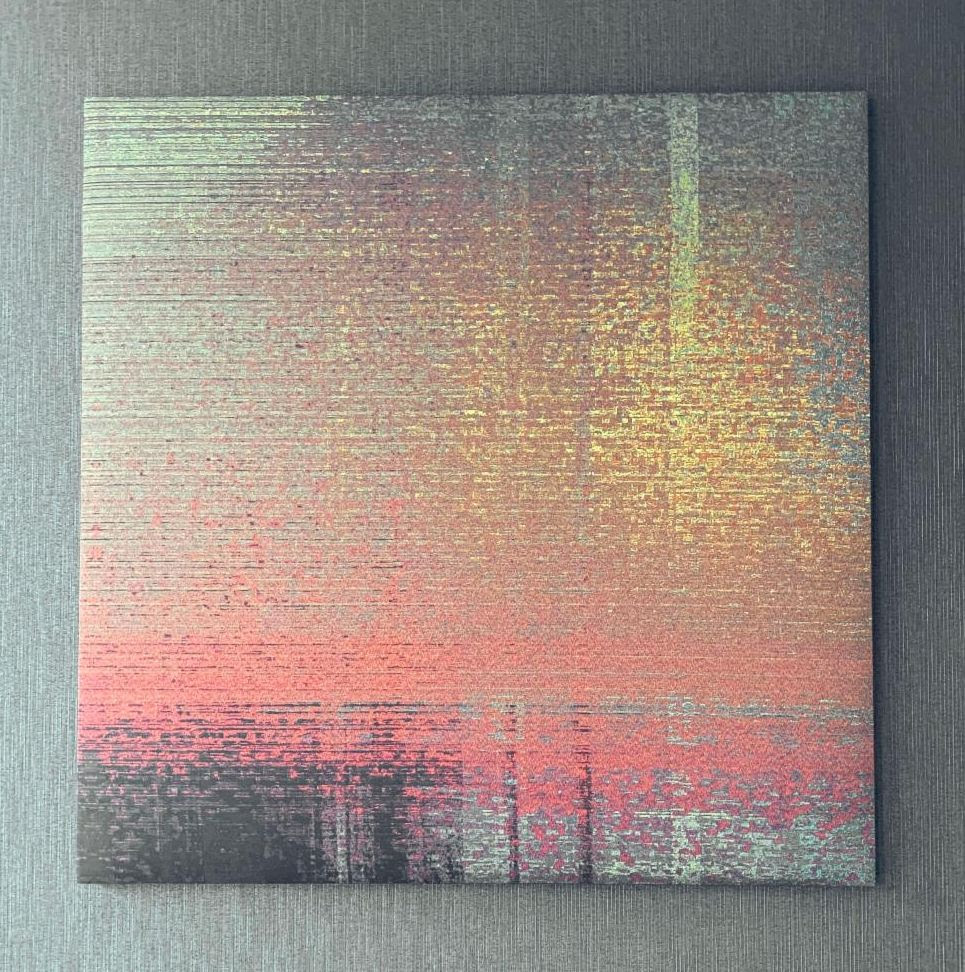
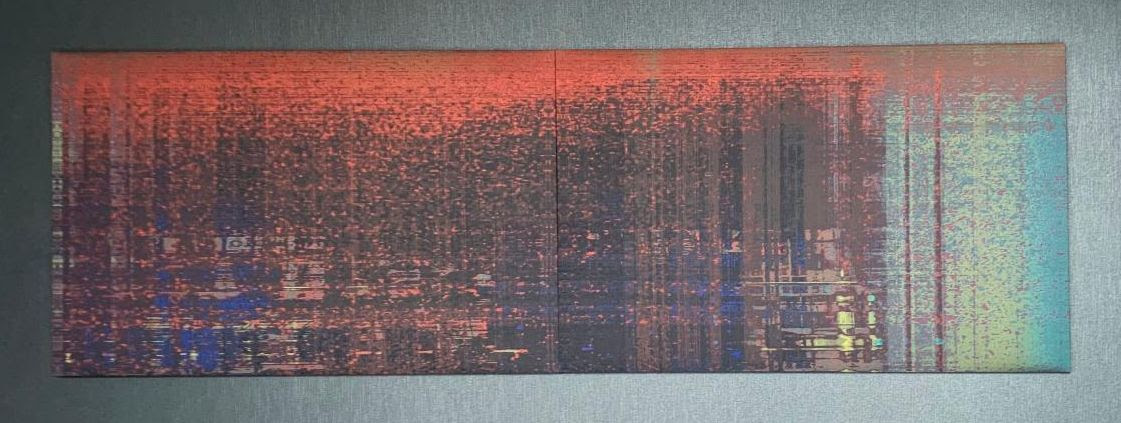
Blue Plaid hangs on the north wall of the lobby of the Hilton Okinawa, which was built right beside the Pacific Ocean. Red Plaid graces the south side of the lobby. Because of oversize windows, Red Plaid shimmers with the orange resonance of the reflection of the sunrise and sunset, while Blue Plaid harmonizes with daytime views of the Pacific. The compositions are simple, and the artist has evinced a high degree of skill in blending of idealization and realistic sternness to achieve an abstract likeness that expresses not only the indomitable air expected of an accomplished artist, but also those more personal traits that reverence his family home. It is nowadays increasingly difficult to distinguish national boundaries. In Hampton, the dazzling outrageous waves crest and break on the silk canvas. And in the silk screens Nice, South France and Untitled, Jashiki realizes phenomena by a stray shaft of ocean and sky light coming through sheer veil spilled over the silk screen. The restriction to horizontal or vertical strokes in Blue Plaid and Red Plaid echoes the image edge. As a result, his work has greater richness of texture and shading than could be achieved simply by depth of color and suggests the interplay of gradient and linearity. Western abstraction has been achieved with Zen-like simplicity, by means of a masterly use of materials. Jashiki’s art is the supreme rebuttal to Greenberg’s dismissal that Minimal Art is “too much a feat of ideation and not anything else.” [6]
images:
Minimal painting still has all the elements of composition
and structure and creativity and form according to Frank Stella. [7] In
Jashiki's work, "nothing is minimal about ... the craftmanship, inspiration,
and aesthetic stimulation" as John Perrault points out. [8] Whether in
painting, curtain, tryptic, or screen, Jashiki creates both realistic and
highly abstract motifs to covey a romantic feeling. as the artist notes "
[in fashion] there are so many contrasts and uses of those elements
coexist harmoniously. Eastern/Western, traditional/modern, fine art/commercial
design, hand work/high tech (CAD). The interplay of those elements is my
chronicle as well."
However ardently some partisans may advocate for Okinawan
independence, it has been almost half a century since the United States
formally returned the islands to Japanese control, and Japanese influence is
pervasive there. So, it is quite natural that Jashiki's art should celebrate
Japanese aesthetic ideals such as pristine elegance, painstaking craftmanship,
and celebration of nature's beauty.
American appreciation for Japanese culture long pre-dated
the battle of Okinawa and the Second World War. During the 1860s, the initial
period of "Japan Fever" sparked the US to ratify a trade and
friendship treaty with Japan. The 1876 World’s Fair in Philadelphia exposed the
broad public to Japanese artifacts and spurred industrial promotion of Japan.
"[A]appreciation of Japanese art encompassed both its own aesthetic merits
and its effect on the industrial revolution" [9] and later in the 19th century
more and more Americans more became familiar with Japanese culture and objects.
In fact, as usual, art appreciation preceded the elevation of Japonisme to “a
truly worldwide worldwide status [through] commercial negotiations (sometimes
among several nations), trade agreements and political machinations and
pressure, combined with the personal energy of two generations of
entrepreneurs" [10]
Unlike the French and English passion for Japanese art, the
initial American enthusiasm for Japanese art owed very little to the wood
print, the photograph, or indeed any works on paper [11]. However, in due
course the American craze for Japanese art objects would become more comprehensive.
Jashiki's work is eclectic in topic, falls into many different categories, and has evolved beyond any particular philosophical school. It raises craftmanship to the highest level of art. It participated in the artistic revival of naturalism, and on the silk print, in turn was impacted by it. Its meaning and structure acted as a stimulus in his personal drive toward abstraction.
Notes:
*The first island chain refers to the first chain of major
archipelagos out from the East Asian continental mainland coast. Principally
composed of the Kuril Islands, Japanese Archipelago, Ryukyu Islands, Taiwan
(Formosa), the northern Philippines, and Borneo; from the Kamchatka Peninsula
to the Malay Peninsula. *https://en.wikipedia.org/wiki/First_island_chain
**Rewoven: innovative Fiber Art exhibition catalogue, TAAC, QCC Art Gallery/CUNY, Godwin Ternbach Museum/CUNY, Kaohsiung Museum of Fine Art, 2017
[1] The Kingdom of Ryukyu existed from 1429 to 1879; it lost
its independence in 1609 after invasion and subsequent domination by Japan, but
Okinawa was not formally absorbed into Japan until 1879. Thus Okinawans had
been Japanese citizens for barely two generations at the outbreak of World War
II. Nevertheless, in the wake of the battle of Okinawa, the United States
severed Okinawa from Japan after the war and occupied it until 1972. [By
comparison, the American occupation of mainland Japan ended in 1952.] During
this period, American bases utilized as much as 80% of the available land in
Okinawa, the American dollar was the official currency, and vehicular traffic
drove on the right. Currently, there are approximately 25,000 American troops
stationed in 30 bases in Okinawa.
[2] Lee et al, catalogue for Rewoven:
Innovative Fiber Art, QCC Art Gallery/CUNY, Godwin Ternbach
museum/CUNY, Kaohsiung Museum of Fine Art, Taiwanese American Arts
Council, 2017, p 110
[3] Ibid.
[4] Robert Sokolowski, Introduction to Phenomenology,
Cambridge University Press, 2000, p.4
[5] Ibid, p. 11
[6] Edward Strickland, Minimalism: Origins,
Indiana University Press, Bloomington, 1993, p. 273
[7] Gregory Battcock, ed. Minimal Art,
University of California Press, 1968, p. 180
[8] "Minimal Abstract by John Perreault",
in Gregory Battcock, ed. Minimal Art, University of California
Press, 1968, p. 260
[9] Julia Meech and Gabriel Weisberg, Japonisme
Comes to America, Harry Abrams Inc., New York, 1990, p.17
[10] Ibid, p. 18
[11] Ibid, p. 19
More information about artist Hiroshi Jashiki
Internet Profiles
https://hiroshijashiki.com/
Hiroshi Jashiki
Hiroshi Jashiki is a textile artist who was born in Okinawa.
Growing up in this semi-tropical, amazingly diverse island, his interests in
arts and crafts, and international cultural sense came naturally from his
earliest years.
Jashiki went to Ryukyu University in Okinawa where he
studied arts and traditional crafts including hand woven textiles. Later he
studied at Cranbrook Academy of Art in Bloomfield Hills, Michigan, where he
received his MFA in Fiber Art. Jashiki moved to NY and worked in the
fashion industry as a textile designer for 20 years. In 2006, he became an
independent textile artist creating original print and handwoven pieces for
shows and for public spaces.
In his print work, Jashiki employs textile software as a
tool to create images inspired by nature, Okinawa, and New York City among
other influences. He has exhibited his work in US and Japan; some of the
galleries include Cranbrook Art Museum in Michigan, Renaissance Fine Art,
Nippon Club New York, and in Japan, Shibatacho Gallery Osaka, Kasagi Gallery
Kamakura, Okinawa Contemporary Art Museum, and Atos Gallery.
His latest project is a series of prints for Rihga Royal
Gran Hotel, Hilton Okinawa Chatan Resort, Blossom Naha in Okinawa, Courtyard
Marriott Tokyo Station, and Ashiya Bay Court club Hotel Resort in Kobe, Japan.
Hiroshi Jashiki artist statement
My encounter with local textile was an affair. Although
Okinawan textiles play an important role in Okinawan History, my meeting with
“it” was not until my late teens, specifically on one afternoon in Shuri High
School. I was helping textile major students get ready for their graduate
exhibition. I noticed first the smell of Ryukyu Indigo, and then the softness
of handspun silk, and last modern geometric patterns. The experience was
emotional. “Falling in love” maybe. Not like lovers but like a baby meeting its
mother for the first time. I felt warm and protected just by touching the
fabric. The affair left an imprint on me.
A recent boom in tourism has pushed developers to carelessly build luxury condos, high-end hotels and malls in Okinawa. Eventually booms bust; you can’t count on them in the long run. The flipside--we gain little or nothing culturally. Okinawans pay less attention to their cultural assets in terms of “old” under the circumstances. The Islands have abundant cultural assets: textiles, pottery, music, dance, and more. They’re beautiful, shape our identity and make us different from the rest of Japan and the world. Cultural assets also are a power to share with the global community. And eventually they will help the Okinawan economy. There is no “old “or “new” in cultural assets. They are timeless. They just need close attention, nurturing, and helping hands to evolve with time. That is the reason I use textile medium and an Okinawan aesthetic in my art.
Okinawa (Ryukyu Kingdom) - historical foundation for
modern culture
The Government of the Ryukyu Islands was the self-government
of native Okinawans during the American occupation of Okinawa. It was created
by proclamation of the United States Civil Administration of the Ryukyu Islands
on April 1, 1952 and was abolished on May 14, 1972 when Okinawa was returned to
Japan, in accordance with the 1971 Okinawa Reversion Agreement. The government
consisted of an executive branch, a legislative branch, and a judicial branch.
Members of legislature were elected. The legislature made its own laws, and
often had conflicts with USCAR, who could overrule their
decisions.(https://en.wikipedia.org/wiki/History_of_the_Ryukyu_Islands)
Original E-blast and link
|
|
|
|

|
|

|
|

|
|
|
|
|
|

|

|


|
|
|
|


|
|


|
|
|
|

|
|
|
|
|
|


|
|
|
|


|
|
|
|

|
|
|
|
|
|


|

|
|

|
|
|
|


|


|