聆聽綠色的呼吸,感受綠色的心情,看見綠色的希望。我來自光,我是光的創造者;我是太陽、空氣、海洋、花香、河水...我們將更輕盈,更光亮!
Listen to the breath of green, feel the emotion of green, see the light of green. I came from light, I am the light traveler! I am the light creator. I am sunshine, air, ocean, flower, river...
Écoutez le souffle de vert, sentir l'émotion de vert, voir la lumière du vert. Je suis venu de la lumière, je suis le voyageur de la lumière ! Je suis le créateur de la lumière. Je suis le soleil, l'air, l'océan, fleur, rivière...
Are the effects of aesthetic signs only determined within cultural systems?
Is this ethno-semiological? [1]
Unlike the last several decades, during the 1970s international art never flowed through a single channel to which a label could be attached; art was “diversified, split, factionalized” as Rosalind Krauss notes.[2] This splintering in art historical terms became manifest in Taiwan in the 1980s. Taiwan's history blends influences from its various colonizers; however, in the 1980s Taiwan recaptured its native culture identity, in reaction to being expelled from the United Nations and the lifting of martial law in Taiwan. The current in international trends was superimposed on this sea change in Taiwan’s circumstances in conformity with the conditions of the land and sea, thus forming a rich and complex culture.
In this Artist-To-Watch chapter, we feature stunning watery rice fields by Taiwanese artist Yunming Chang. Upon returning from three months of solo travel in mainland China, he adapted the techniques he had learned to Taiwan's renaissance of self-identity. With this innovation he made evident the connection to his rural roots, both in representational and later in abstract works. Chang dares place bright colors, particularly his characteristic vivid green, in brush ink to carry moisture on to rice paper, and takes as subject the surrounding environment. He demonstrates in a distinctive way a peaceful and pleasing farming life, orderly in a fascinating composition of staggered and horizontal lines. His art points out that seemingly natural boundaries of a rice paddy can be reconstructed and that they transect the painting screen. These countryside scenes, which speak so strongly to us, became his signature genre. A mix of melancholy with joy and exuberance gives these paintings an attractive sweetness. Whereas, the dark black ink smear is thick enough to shout out the unitary and partitioning forces.
Some pieces of his recent work with different symbolism seemingly appeal to diverse portions of the underlying structure of logic. We note that he extends his palette to oil paint and even asphalt. At the age of 50, Chang studied in the US and subsequently traveled around Europe in order to broaden his perspective on art. The results prefigure an image of personal freedom under the premise of pursuing complete liberation in artistic creation. Twentieth century modern art, especially Antoni Tapies (1923–2012), Joan Miró (1893-1983), and COBRA (or CoBrA, [3]) has inspired him. He pays special attention to texture, which he shapes via rough, overlapping, collage etc., Chang's symbolic paintings express his complex emotional discourse and are characterized by the interplay between texture and line, as well as densely rendered colors. Examples are Key to the World and Affix (see below) in mixed media on canvas. He imbues his creations with rhythm and emotion through his innovative signifiers.
Brush ink painting on paper, traditionally seen as a typical Chinese technique, depicts a high mountain and water - in black and white - or the royal color applied in accurate renditions of hierarchy to palace architectural forms. Blank space on the paper is as eloquent as painted areas. However in Taiwan a body of colored ink painting has gradually proliferated its own authority to represent local, ordinary living landscapes. This discourse reaches its highest development in Yunming Chang's painting. If his basic ink painting technique nods to Chinese forbears, his rich tone in color might remind us of gouache painting that can be counted as Japan's influence.
Of course, an entirely accurate, hyper-realistic representation is antithetical to the spirit and conception of ink painting. The artistic imagination must exert its summary action on the scene. A deep green has been poured over the field; it is not a stormy power or gaudy but suggestive of the fresh moisture after the rain. Yet it also hints at a certain morbid lyricism, some kind of vulgarity of elegance. Clouds and sky are lost to view, with attention confined to black outlines of the land in Chang's paintings. The rice field edge loses its definition and is subordinated to the teeming emotion which the field carries. The black boundary is not lost bur repeated and amplified in the timbers of adjacent buildings.
When interrogating the eclectic possibilities in his ink, oil painting and different symbolic language expressions, we find something of the myth as the brush ink, and signs that Chang has taken from ancient cultures. Can we term ethno-semiological these effects of aesthetic?The product of several decades of activity as a professional artist this work unleashes patterns, or endless demolition of the self and negation the past. The operation of the universe is constantly moving simultaneously towards excellency and disorder. It is always Art that supplies Nature's lack, a voice that is a substitute for the voice of Nature.[4]
-- Luchia Meihua Lee, Curator
Notes:
[1] Institutions and Objections: Critical Revision, 1. Jacques Derrida (1930- 2004) 'The Exorbitant: Question of Method and 'the Engraving and the Ambiguities of Formalism', from Of Grammatology, in Art in Theory 1900-2000, An Anthology of Changing Ideas, ed. C. Harrison & P. Wood, 2002. Blackwell: MA, Oxford, pp.946-949
[2] Institutions and Objections: Critical Revision, 12. "Rosalind Krauss (1940-) 'Notes on the index, Part 1', ibid., p.994
[3] COBRA (or CoBrA) was a European avant-garde art movement active from 1948 to 1951
The depictions of horizontal moist and fresh green fields have lingered in the midst of our desolation period, and complements our relentless drive towards high technology.
We hope you do not begrudge praise and admiration.
Summer Countryside, ink & color on rice paper, 2000
Lakeside, Asphalt and oil on canvas, 38 x 57 inches, 2008.
Chang applied asphalt to create a series of mysterious forests, bold black and pure white, reflected in the water and creating a tension, yet also an abstract tranquil beauty.
Secluded residence near water (臨水幽居)
27 x 27 inches, 2005
Yunming Chang 張韻明
Born in southern Taiwan, YunMing Chang currently lives and works in Taipei. He earned an MFA from Lindenwood University in St Luis, Missouri, and a BFA from National Taiwan University of the Arts, Taiwan.
In 1995, he received the Distinguished Alumni Award, National Taiwan University of the Arts. YunMing Chang is well-known as a stylist of color-ink. He has had solo exhibitions in numerous museums and galleries in Taiwan and internationally, such as National Taiwan Museum of Fine Art, Taipei Museum of Fine Art, and Dr. Sun Yat-Sen Memorial Hall Gallery. He also held many solo exhibits at art centers such as that at Lindenwood University; Chinese Cultural Center, Houston; Texas State Museum of Asian Cultures & Education Center, Corpus Christi, Texas; Art Expo, Taipei Cultural Center in New York City.
Some pieces of his recent work with different symbolism seemingly appeal to diverse portions of the underlying structure of logic. We note that he extends his palette to oil paint and even asphalt. At the age of 50, Chang studied in the US and subsequently traveled around Europe in order to broaden his perspective on art. The results prefigure an image of personal freedom under the premise of pursuing complete liberation in artistic creation. Twentieth century modern art, especially Antoni Tapies (1923–2012), Joan Miró (1893-1983), and COBRA (or CoBrA, [3]) has inspired him. He pays special attention to texture, which he shapes via rough, overlapping, collage etc., Chang's symbolic paintings express his complex emotional discourse and are characterized by the interplay between texture and line, as well as densely rendered colors. Examples are Key to the World and Affix (see below) in mixed media on canvas. He imbues his creations with rhythm and emotion through his innovative signifiers.
A view of the fishing grounds (漁塭一景), ink and color on rice paper, 27 x 27 inches. 2015
Key to the World, Mixed-media on canvas, 36 x 28 inches, 2016.
In the gold area, the paint is embodied with ropes. The lines symbolize the different lives that people lead. The circle represents a keyhole, a place to turn the switch and explore the unknown future.
Landscape, Chinese ink & color on rice paper, 54 x 11 inches, 2000
During a trip to Colorado, the scenery reminded Chang of the painting Autumn Colors on the Que and Hua Mountains (鵲華秋色) Zhao Mengfu (趙孟頫, 1254–1322), Yuan Dynasty (1279–1368). The conical hills recall one of the dominant hill types in Northern China. Chang augmented the original with his lemon yellow and green colors, and a layering laying to create a sense of depth. This pattern of organization makes his paintings appear very simple and approachable.
Brush ink painting on paper, traditionally seen as a typical Chinese technique, depicts a high mountain and water - in black and white - or the royal color applied in accurate renditions of hierarchy to palace architectural forms. Blank space on the paper is as eloquent as painted areas. However in Taiwan a body of colored ink painting has gradually proliferated its own authority to represent local, ordinary living landscapes. This discourse reaches its highest development in Yunming Chang's painting. If his basic ink painting technique nods to Chinese forbears, his rich tone in color might remind us of gouache painting that can be counted as Japan's influence.
Of course, an entirely accurate, hyper-realistic representation is antithetical to the spirit and conception of ink painting. The artistic imagination must exert its summary action on the scene. A deep green has been poured over the field; it is not a stormy power or gaudy but suggestive of the fresh moisture after the rain. Yet it also hints at acertain morbid lyricism, some kind of vulgarity of elegance. Clouds and sky are lost to view, with attention confined to black outlines of the land in Chang's paintings. The rice field edge loses its definition and is subordinated to the teeming emotion which the field carries. The black boundary is not lost bur repeated and amplified in the timbers of adjacent buildings.
When interrogating the eclectic possibilities in his ink, oil painting and different symbolic language expressions, we find something of the myth as the brush ink, and signs that Chang has taken from ancient cultures. Can we term ethno-semiological these effects of aesthetic?The product of several decades of activity as a professional artist this work unleashes patterns, or endless demolition of the self and negation the past. The operation of the universe is constantly moving simultaneously towards excellency and disorder. It is always Art that supplies Nature's lack, a voice that is a substitute for the voice of Nature.[4]
-- Luchia Meihua Lee, Curator
Notes:
[1] Institutions and Objections: Critical Revision, 1. Jacques Derrida (1930- 2004) 'The Exorbitant: Question of Method and 'the Engraving and the Ambiguities of Formalism', from Of Grammatology, in Art in Theory 1900-2000, An Anthology of Changing Ideas, ed. C. Harrison & P. Wood, 2002. Blackwell: MA, Oxford, pp.946-949
[2] Institutions and Objections: Critical Revision, 12. "Rosalind Krauss (1940-) 'Notes on the index, Part 1', ibid., p.994
[3] COBRA (or CoBrA) was a European avant-garde art movement active from 1948 to 1951
[4] op. cit. Derrida p.949
Affix(綴), mixed media on canvas,
69 x 27 inches, 2020
Light of Lake and Mountain (湖光山色), ink & color on rice paper, 54 x 27 inches, 2019
Four Seasons (four panels), ink & color on rice paper, 54 x 27 inches each, 1992
Details of Four Seasons, from it reflection of the water to greenish plants and yellow grain and the only winter traces.
Statement by artist Yunming Chang
Su Dongpo's wrote "Life is like a dream. Allow me to offer a drink to the river, the moon and its reflection." I say that if my life is a dream, then I raise a toast to art!
I shouldn't be an artist, but a fisherman or a laborer, but fate is so wonderful. I was born in a very remote fishing village in southern Taiwan; there were only 6 families with no water or electricity, and the houses had thatched roofs. After graduating from elementary school, I had to work on a fishing boat fishing with my father and brother. But I got seasick frequently and was not cut out to be a fisherman! In despair, my family had to borrow money for me to continue studying.
The most important thing for an artist is to keep creating! Treat artistic creation as a lifelong pursuit! The older you are, the fewer your good friends, and no matter how much you say or how fluent you are about your work, you will inevitably be lonely! To paraphrase Su Dongpo, "human life is fleeting, accidental, and temporary - just like a bird’s footprints in mud."
Artist to Watch: YunMing Chang 張韻明 - Reverie on the green rice fields of Taiwan https://youtu.be/cbDUPOFvRzc
水畫廊 張韻明油畫 2014.12.26
https://youtu.be/utZLGeoIz4o
email: artist.taiwan@gmail.com
After the Rain (雨後)
ink & color on rice paper,
27 x 27 inches, 1994
Scarves with images of YunMing Chang's art
Material: 100% virgin wool
Property: Top quality 13um Albas virgin wool, with CQA washing, carding, natural dyeing, spinning, weaving, finishing – in all, more than one hundred processes.
** Reaching Hermes standards.
Characteristic:World class art works with vivid, natural colors. Non-allergenic, delightful to the touch, and environmentally friendly, this reversible scarf feels like cashmere.
Mask, Mixed-media on canvas, 47 x 47 inches, 2017
Indigenous totems mixed with his signage appeared in Chang's later works.
Contact: info@taac-us.org if you are interesting to support this artist in any creative way.
The Song of Thousand Winds -Mourning Mr. Democracy of Taiwan
Lee Teng-hui 千の風になって
We mourn the loss of Taiwan‘s former President Lee Teng-hui. Saluted as Mr. Democracy, he laid the foundation for Taiwan ‘s democracy beacon, which will guide Taiwanese ahead with courage for generations. He was a respectable and humane politician, philosopher and apostle. I was on the governmental duty just at the time when Lee was Taiwan's President, and thus was able to observe his exquisite reorganization of the country. Just as President Lee, my father was born during the Japanese colonization of Taiwan. and their adult lives played out in various stages of Taiwan's history. They were thus enriched by the multiple cultural influences of an era of historical change, and naturally were able to selectively absorb the cultures of other countries. It
is in this environment that they sought all kinds of knowledge from predecessors - like a sponge, as Dr. Thomas Lee mentioned in his article about Lee Teng-hui.
Each day fades away wistfully, and broken memory is hard to touch, however this great former president's figure has never been distant. It does not diminish President Lee's legacy that he is a controversial figure in Taiwan - many refugees from mainland China were quite happy with the undemocratic status quo. The significant change he initiated in Taiwan will not be reversed, unless of course the communists invade successfully.
Former President Lee Teng-hui mentioned that he sang a Japanese song " I am a Thousand Winds" at his 86th birthday banquet. Former President Lee said that when he was young, he often wondered what would happen after death. When he was 16 in high school, he wrote an article entitled "Why do people die?" During his high school years, he reached no greater insight than thinking that if people die, they will become part of nature; but recently upon hearing "Song of I am a Thousand Winds" he "deeply realized the nature of death." No other song has described death so profoundly and nature with such optimism."
I would also like to share the article by Dr. Thomas H. C. Lee (李弘祺) who is faithful to its subject. I enjoyed it and found it touching. Apostle. Philosopher. A great figure with both heroes and magnates──in memory of Mr. Lee Teng-hui (使徒.哲人.英豪兼具的大人物──紀念李登輝先生) , Thursday, July 30, 2020 @ Voice Tank, you can read the whole article below or click the link.
"Do Not Stand at My Grave and Weep" is a poem attributed to be written in 1932 by Mary Elizabeth Frye. Although the origin of the poem was disputed until later in her life, Mary Frye's authorship was purportedly confirmed in 1998 after research by Abigail Van Buren, a newspaper columnist.[1]
•Do not stand at my grave and weep
I am not there. I do not sleep.
I am a thousand winds that blow.
I am the diamond glints on snow.
I am the sunlight on ripened grain.
I am the gentle autumn rain.
When you awaken in the morning's hush
I am the swift uplifting rush
Of quiet birds in circled flight.
I am the soft stars that shine at night.
Do not stand at my grave and cry;
I am not there. I did not die.
The Song of I am a Thousand Winds 千の風になって
A single released by Japanese vocalist Masashi Akikawa on May 24, 2006
千風之歌 (千の風になって)
不要佇立在我墓前哭泣 因爲我並不在哪裏
我並沒有離開人間,我並沒有沉睡不醒
我已化成千風 化成千縷微風 翺翔在無限寬廣天空裏
我已化成千風 化成千縷微風 翺翔在無限寬廣天空裏
秋天 我化成陽光 照射在田野閒
冬天 化作白色雪 綻放鑽石光芒
晨曦升起時, 幻化為飛鳥 輕聲喚醒你
夜幕低垂時,幻化微星辰 溫柔守護你
不要佇立在我墓前哭泣
因爲我並不在哪裏 我並沒有離開人間
化成千風 我已化成千縷微風 翺翔在無限寬廣天空裏
愿-生生不息-- a tenor solo and chorus version video below:
https://youtu.be/jcRBtTtP9f8
https://youtu.be/JRtwNqlV4X4
The article by Dr. Thomas H. C. Lee is faithful to its subject. I enjoyed it and found it touching.
使徒.哲人.英豪兼具的大人物──紀念李登輝先生 Thursday, July 30, 2020 李弘祺
Reforming art and cultural activities to meet today’s needs can be a great way to promote harmony.
by Luchia Meihua Lee
New York artist Felipe Galindo, has dedicated himself to creating humorous art in a variety of media, including cartoons, illustrations, animations, fine art and public art. He is also an arts educator. Many of Felipe's "It Used / Reused" ongoing series drawings remind of us pre-pandemic life and highlight the differences. the new life been giving to the used bag, cup and boxes the image that profile the continues living style in the city, while we are turned away from people by a lingering, invisible threat. Figures appear in parallel or in a semicircle or diagonally across from each other in the drawing's clustered space, the bodies either half-turned away from us, or shown in profile. These people do not wear face masks, but neither do they open the mouth; they rather fall into a friendly but silent atmosphere.
The drawings from the Used / Reused series have been compiled with Felipe Galindo‘s eye for reusing hang bags, train or bus tickets and subway maps, as well as paper cup and take out boxes. Preceding the pandemic, they nevertheless shed new slight on our new socially distant lives, as evidenced by the guarded conversation between figures in the drawings, figures scattered seemingly at random and placed unwillingly on the same plane. There is no tangible emotion or special anguish expressed by these people.
In "Coffee Shops III-VI, they are situated behind and in front of counters that turn out to be familiar take-out cups unrolled in semicircular arcs in settings such as the cafes or bars where patrons play with cell phones or computers. Viewed in light of Covid-19, these scenes are reminiscent of one's affection for what has been cast off in these pandemic days. They are perfectly chosen for this moment. Paradoxically, we seem to be working and thinking disconnectedly in the virtual world in the midst of the virus. Imagine arranging in-person visits to museums, galleries,and auction houses to view original art works. Such actions have been abandoned and Feggo searches for a new folk song to reflect our altered realities. This year, we have had to turn away from the crowd in an immense grief for those lost. We have been admonished to disrupt the expectation of lip glamour in noisy conversation, the glass raised in toast, to public ecstasy in dinning. The subway crowds of various ethnicities, postures, actions, and expressions is a gift that no longer exists. Repelled by the absence of trivial daily details, we are isolated more and more from our own surroundings.
In these drawings by Feggo, the fragmented individual works boast no pompous air, but are defenseless to society's inflicted pain. Their characters swim in indifferent terms and ordinary features. However, they exhibit a remarkable organic and intuitive togetherness, a timely change from the sharp satire and the black humor that we have seen in Feggo's other animations and drawings. His drawings bear down on sepia -tinged photographs with an atmosphere of infinite poignancy, release a light sorrow, which is somehow still in harmony with the rest and produces a relaxed, warm, light attitude. It hangs on the act of observing, hence the amusing behavior induced in the spectators becomes an important but subtle component of this art.
A complete interview by Bronxnet:
Mexican Studies Oral History Project: Felipe Galindo “Feggo”
Urban Tribes II-Urban Reverence (exhibition paused due to coronavirus)
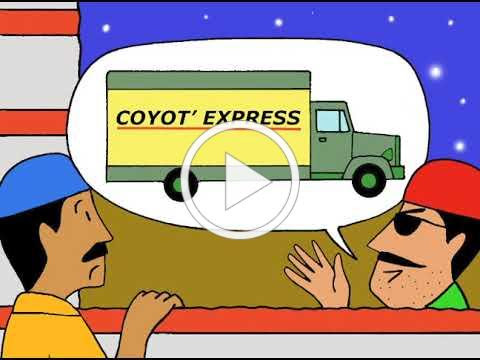
Manhatitlan Codex, created by Felipe Galindo (Feggo), is a humorous digital animation, inspired by Aztec mythology and pre-Columbian codices, which narrates an imaginary migration of Mexicans to New York. It’s also informed by the voyage of the pilgrims in the Mayflower and historical human trafficking to America.
Manhatitlan Codex explores the challenges related to the universal immigrant experience, such as impermanence, uncertainty and fragmentation, while at the same time presenting a witty and unusual look at this important issue.
Felipe Galindo (Feggo),
Manhatitlan Codex,
2008, 5:30 min.
Reforming art and cultural activities to meet today’s needs can be a great way to promote harmony. TAAC's core commitment is through art to practice diversity, equality, and inclusion. Building bridges between communities, national and internationally through art and culture to deepen our senses of beauty, inspiration, and empathy.
By advancing these goals and building these bridges in the art world, we aim to promote a more just society. TAAC hopes that outrage will help to lead to a more equitable society, truer to our ideals.
New York artist Felipe Galindo, has dedicated himself to creating humorous art in a variety of media, including cartoons, illustrations, animations, fine art and public art. He is also an arts educator.
Many of Felipe's "It Used / Reused" ongoing series drawings remind of us pre-pandemic life and highlight the differences. the new life been giving to the used bag, cup and boxes the image that profile the continues living style in the city, while we are turned away from people by a lingering, invisible threat. Figures appear in parallel or in a semicircle or diagonally across from each other in the drawing's clustered space, the bodies either half-turned away from us, or shown in profile. These people do not wear face masks, but neither do they open the mouth; they rather fall into a friendly but silent atmosphere.
The TAAC team wishes you a safe time
When the conversation turned to the vague?
The drawings from the Used / Reused serieshave been compiled withFelipe Galindo‘s eye for reusing hang bags, train or bus tickets and subway maps, as well as paper cup and take out boxes. Preceding the pandemic, they nevertheless shed new slight on our new socially distant lives, as evidenced by the guarded conversation between figures in the drawings, figures scattered seemingly at random and placed unwillingly on the same plane. There is no tangible emotion or special anguish expressed by these people. In "Coffee Shops III-VI, they are situated behind and in front of counters that turn out to be familiar take-out cups unrolled in semicircular arcs in settings such as the cafes or bars where patrons play with cell phones or computers. Viewed in light of Covid-19, these scenes are reminiscent of one's affection for what has been cast off in these pandemic days. They are perfectly chosen for this moment. Paradoxically, we seem to beworking and thinking disconnectedly in the virtual worldin the midst of the virus. Imagine arranging in-person visits to museums, galleries,and auction houses to view original art works. Such actions have been abandoned and Feggo searches for a new folk song to reflect our altered realities. This year, we have had to turn away from the crowd in an immense grief for those lost. We have been admonishedtodisrupt the expectation of lip glamour in noisy conversation, the glass raised in toast, to public ecstasy in dinning. The subway crowds of various ethnicities, postures, actions, and expressions is a gift that no longer exists. Repelled by the absence of trivial daily details, we are isolated more and more from our own surroundings.
In these drawings by Feggo, the fragmented individual works boast no pompous air, but are defenseless to society's inflicted pain. Their characters swim in indifferent terms and ordinary features. However, they exhibit a remarkableorganic and intuitive togetherness, a timely change from the sharp satire and the black humor that we have seen in Feggo's other animations and drawings. His drawings bear down on sepia -tinged photographs with an atmosphere of infinite poignancy, release a light sorrow, which is somehow still in harmony with the rest and produces a relaxed, warm, light attitude. It hangs on the act of observing, hence the amusing behavior induced in the spectators becomes an important but subtle component of this art.
--- Luchia Meihua Lee, curator
A complete interview by Bronxnet:
Mexican Studies Oral History Project: Felipe Galindo “Feggo”
Living and working in New York City, Felipe Galindo was born in Cuernavaca, Mexico. He earned a BFA in Visual Arts from the National Autonomous University of Mexico. His humorous drawings have appeared in The New Yorker, The New York Times, The Nation, The Manhattan Times, The Wall Street Journal, Reader's Digest, Mad, Narrative, NACLA, INXart.com, El Chamuco (Mexico) and numerous European publications (for example,The Spectat https://conta.cc/305TfmGor, Private Eye, Prospect and Oldie in England, Ode in Holland, International Herald Tribune, France; Red Bull F1 in Austria, Haüser in Germany.)
Felipe Galindo
Galindo has held numerous individual exhibitions in the United States and abroad.
Recent awards include: Ciudad de Las Ideas, Puebla, Mexico; Porto Cartoon Festival, Portugal; Aydin Dogan Success Award, Istanbul; Zagreb Cartoon, Croatia; Ministry of Tourism Cartoons Competition Award, Antalya, Turkey; The United Nations Ranan Lurie Political Cartoons; "People's Prize," Knokke-Heist Humorfest, Belgium; Greek Ministry of Culture Honorable Mention; "People's Choice Award," Omiya Festival, Japan. His books are: “Cats Will Be Cats” (Plume/Penguin), Manhatitlan (J. Pinto Books), “No Man Is a Desert Island” (J. Pinto Books), “George Washington: Back In New York City” (Now What Media).
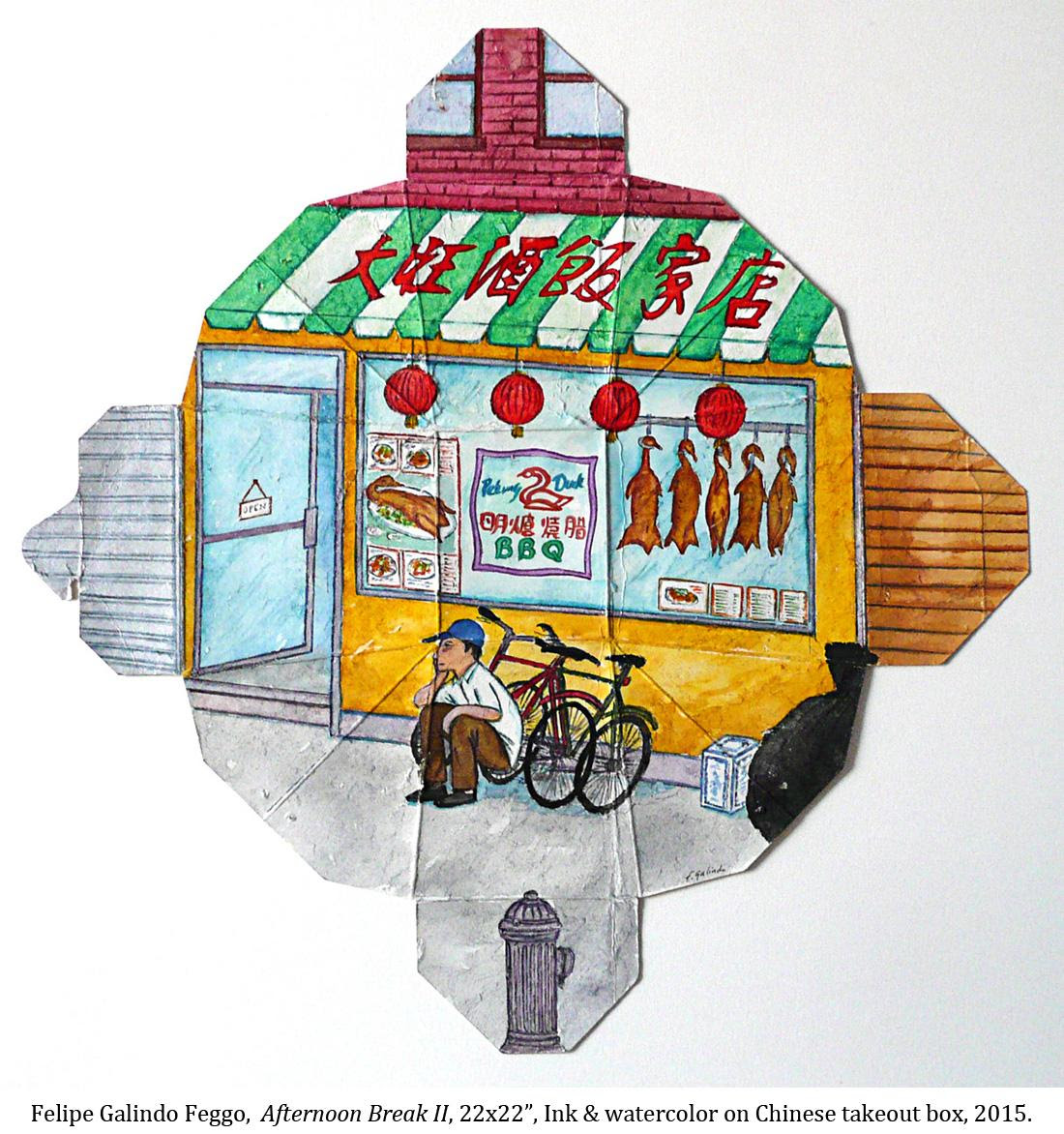
He has an ongoing series of works on disposable materials called “Used/Reused” in which he uses discarded materials to incorporate sketches of every day life in the city.
He created “Magic Realism in Kingsbridge,” a series of 4 permanent public artworks fabricated on glass based on Galindo’s humorous designs. They are installed at the 231st Street subway station platforms of the No. 1 subway line in New York City, commissioned by the MTA-Arts for Transit Program.
Statement by artist Felipe Galindo
Used / Reused
Drawings & Mixed media
I have been sketching scenes of New York City since my arrival from Mexico in the early 1980's. As I have walked its streets, enjoyed its parks, museums, coffee shops, riding the subway, buses, etc. I have tried to capture the nuances of the city and its human landscape with my pens and sketchbooks. If a subject fascinates me, I immediately try to capture the moment. This imagery on ephemeral materials offers my view on the everyday life of my adopted city. This particular presentation, of loosely drawn vignettes, contrasts with my more precisely rendered works of my other body of work of cartoons and illustrations.
Used / Reused is an on-going series of mixed media works inspired by the graphic qualities of packaging materials, in which I explore the possibilities of using disposable materials (paper bags, tin cans, boxes, coffee cups, maps, etc.) as physical support for sketched drawings, to make visual commentaries, superimposed on familiar objects we use, take for granted and discard continually. I intend to give new life to these disposable materials, and at the same time, a different one to my drawings.
How ancient art influenced modern art - Felipe Galindo